Contents
DOC-04 / Conceptual reference
codex
/ˈkəʊ.dɛks/·n.
How Synedre actually works. Not the doctrine, not the vocabulary — the machinery: architecture, the life of a chantier, the learning loop.
9 chapters
Chapter 00
The Human at the Centre
Why a human — not the system, nor a committee, nor the machine — must hold the centre. Power is not legitimacy; no corpus is neutral; only a human can doubt the consensus and answer for it.
Why a human at the centre — and not the system, nor a committee, nor the machine, the most powerful of the three? Because power is not legitimacy. Wukong leaps farther than all, and is placed below them. What makes the centre legitimate is not its strength: it is that it answers for everything, and serves an end higher than itself.
Everything that endures is centralised — the solar system, the nucleus of an atom, the brain of a body. Pure decentralisation, in nature, has a name: dust. But to centralise is not to tyrannise: the sun does not dictate the lives of the planets, it holds them in orbit and gives them light. A centre can give, like the sun, or devour, like the black hole — what separates them, in a man, comes down to two words: to answer, and to serve.
Why not a machine, then? Because none is neutral: its corpus is already influenced, and the unanimity of several machines is often only a single influence repeated — this myth has tested it, judged in opposite directions by AIs of different heritages, each according to its training. The human is not neutral either; but he alone can doubt the consensus, choose against it, and answer for his choice. The centre is not the one who sees the truth — no one sees it; it is the one who can refuse the machines’ unanimity and bear the weight of it. Not by privilege: by burden.
Chapter 01
The Architecture
One mothership, agentic arms, a single source of truth.
Synedre is not a piece of software: it is a topology. At its centre, the human — the founder, who decides and answers for everything. And the centre does not move: what travels is Shyrka (シルカ). The mothership, a single intelligence that holds the context, carries the founder’s intent far out and roams the system in his stead — without ever deciding in his place. He himself stays still; he travels through the mind of the machine. Around it, the agents: thirty advisers, each with a heritage, a role and a way of thinking. Beneath them, the automates: deterministic scripts that handle the plumbing and never improvise.
Everything converges on a single point: one database. No business data lives in a static file. The database is the only source of truth — the code is merely its reflection. This is the rule that keeps the system from drifting: when two files contradict each other, the database always wins.
This architecture is named after its totem animal: the octopus. Shyrka is its head, the agents its semi-autonomous arms, and the shell is shed on purpose — the exact opposite of proprietary lock-in. The octopus is the machine; the human is not part of it: he is the one it serves.
Chapter 02
The Agent and the Automate
The agent thinks; the automate executes. The border is sacred.
Synedre’s second law fits in a single sentence: the agent thinks, the automate executes. An agent exists for creative work — drafting, arbitrating, deciding. An automate exists for plumbing — inserting, synchronising, checking.
The dividing rule is simple: every repeatable process must become an automate. If Shyrka does plumbing by hand, an automate is missing. Conversely, a decision is never handed to an automate: a script that judges is a script that fails in silence.
This border protects both worlds. It reserves the agents for what only intelligence can do, and hands the rest to machines that never tire.
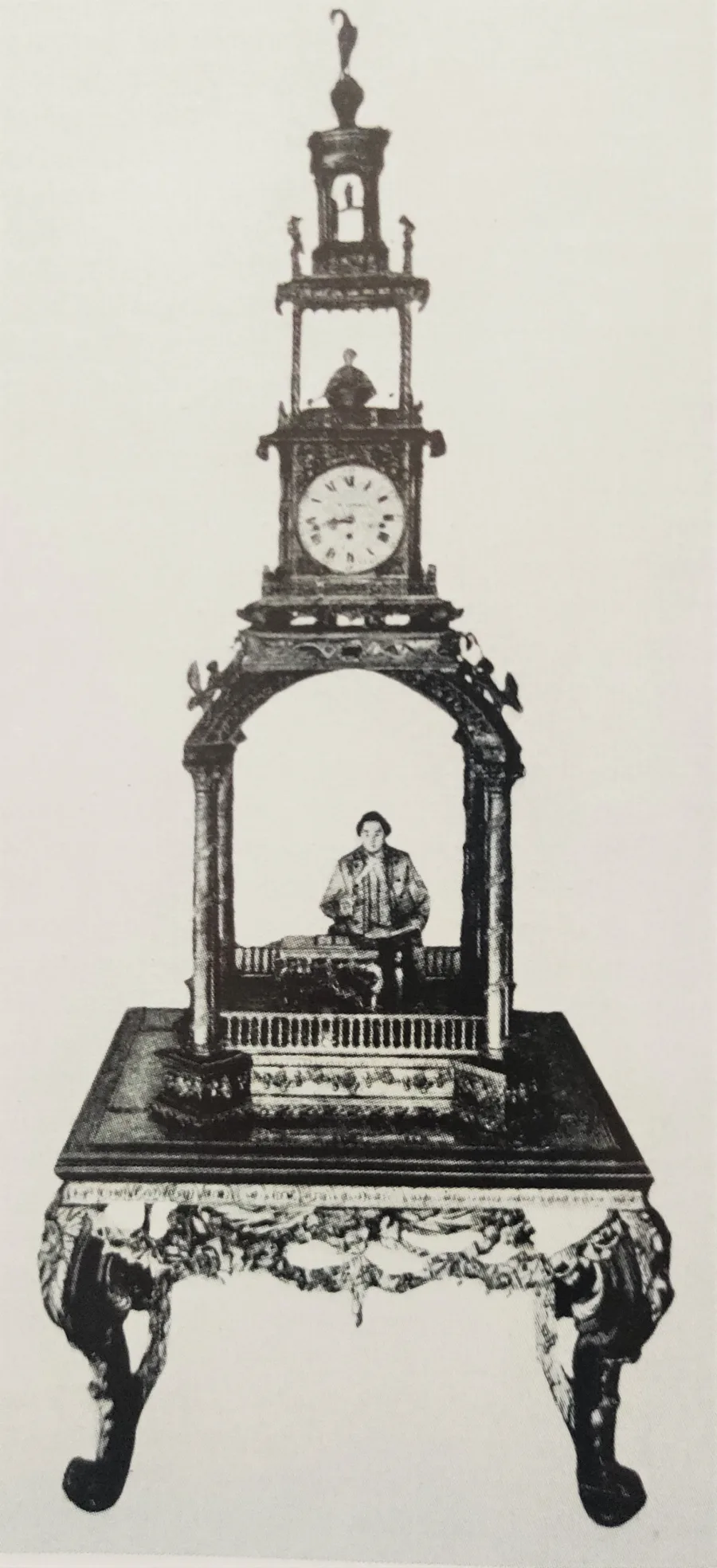
Calligrapher automaton (Jaquet-Droz – H. Maillardet workshop), in a Williamson clock (London), found in Peking. Plate, Palace Museum catalogue, Peiping, 1933 — public domain.
Chapter 03
The Three Orbits
Direction, framing, execution. The Founder stays fixed at the centre.
The agents do not form an org chart: they orbit. Three orbits, set by the distance from the heart of the decision.
- Orbit I — Direction: those who see far.
- Orbit II — Framing: those who verify before acting.
- Orbit III — Execution: those who build.
The orbits turn; the Founder stays fixed. An agent may change orbit from one chantier to the next, but the centre of gravity never moves: the final decision, and the hands on the keyboard at the moment of shipping, belong to the Founder.
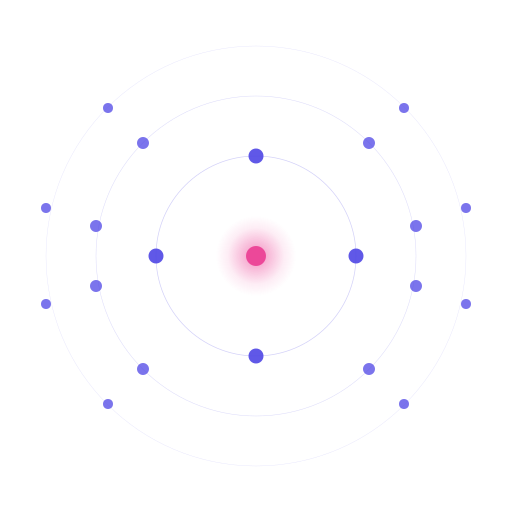
The three orbits in motion: the agents gravitate around the fixed Founder, at three distances from the decision.
Chapter 04
The Life of a Chantier
From intent to production, in five movements.
Synedre’s unit of work is the chantier. It is never born from a shortcut: a strict procedure frames it, from reading the request to the explicit recruitment of agents.
A chantier breaks down into travaux, and those into tasks assigned to named agents. Nothing is handed "to the backend by default": every recruitment is justified, and a client chantier always mobilises at least two distinct disciplines.
Then comes the five-beat rhythm: frame → execute → review on preprod → ship → engrave the lesson. Going to production is asymmetric: the intelligence deploys to preprod without asking, but only the Founder’s hand validates production. This is the last law — the Founder has the hands.
SYSTEM / Orchestration
The Orchestration
How an intent becomes a delivery. Five sequential phases, a chain of responsibility traced end to end.
the Founder
Directs & Decides
Atlas — Orchestrator
Analyses the task, dispatches agents, synthesises reports.
Context
Data, monitoring, vision
Framing
Strategy, ROI, Compliance
Execution
15 domain agents
Validation
12 post-commit agents
Post-Ship
Infra, docs, after deploy
Health
Wi WinnicottFull session
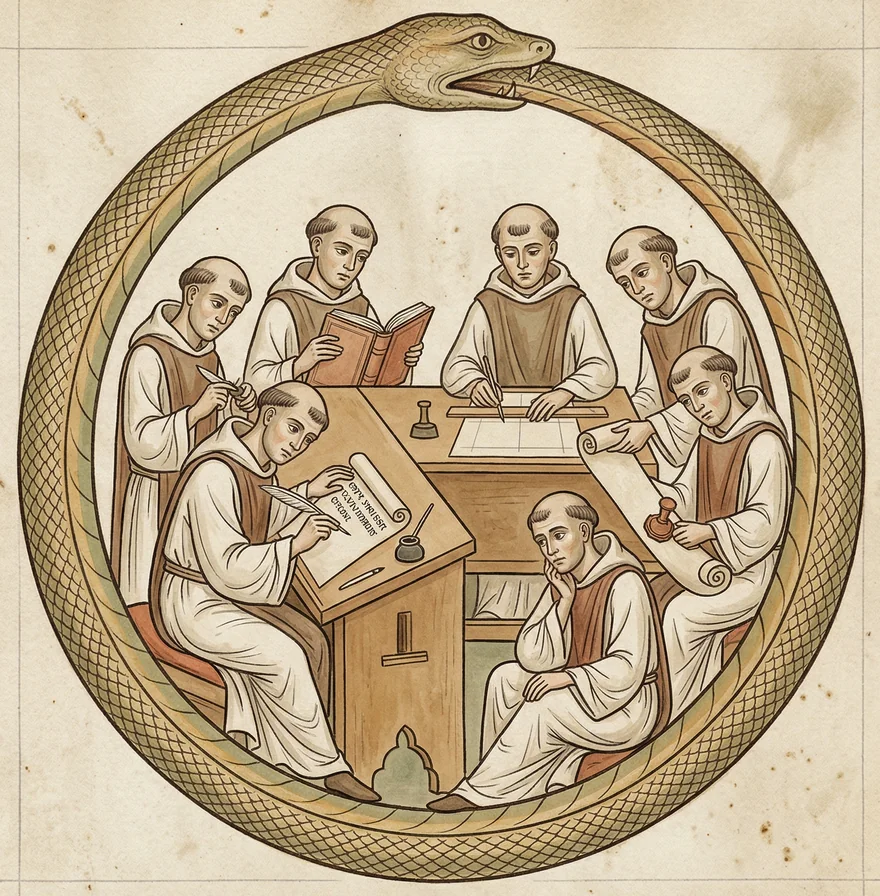
The Liturgy of the Hours
30 Automations · 7 castes
4 scheduled · 26 on-demand
The Agents think. The Automations execute.
Renoir
Stage Director of Automations
Horlogers
Monitoring
7 scripts
Oracles
Anticipation
7 scripts
Bâtisseurs
Infrastructure
6 scripts
Tisserands
Maillage
3 scripts
Vigies
Surveillance
3 scripts
Cellériers
Intendance / comptes
2 scripts
Scribes
Création
2 scripts
Verified delivery
Clean code, consistent design, production verified.
The full sequence — cues, representations, director — is formalised in the Conduct.
Chapter 05
The Learning Loop
Every error becomes a scar; every scar, a safeguard.
Synedre does not forgive — it learns. Every error becomes a scar: a fact engraved, dated, tied to the profile of the agent who should have caught it. The scar turns into a check: a safeguard the agent applies on every pass from then on.
An agent never makes the same error twice. This is what makes the collective an organism that strengthens over time instead of repeating its faults.
But a scar is not eternal: it is conditional. When its context disappears — a stack migration, the abandonment of a tool — it is archived, not applied. A rule without context is a superstition. The system engraves, but it also prunes: a tree that never sheds its leaves collapses under its own weight.
Chapter 06
The Three-Tier Memory
Reflex, doctrine, intuition — three memories, one truth.
Synedre remembers on three levels. The working memory — short facts, loaded at every session: the immediate reflex. The second brain — a Zettelkasten where doctrine lives, the why behind decisions, linked note to note. And the semantic memory — a vector search that retrieves the relevant note even when its exact name has been forgotten.
Above these three levels reigns one rule: the database is the only source of truth. Markdown serves only runbooks and doctrines; every reference that changes lives in the database. This is the discipline that keeps knowledge from contradicting itself as it grows.
Chapter 07
The Ouroboros
The system improves through those who contest it. The serpent bites its tail.
The learning loop fixes internal errors. The Ouroboros fixes the blind spots — the ones Synedre cannot see on its own. The principle fits in a single line: the system improves through those who contest it.
On 4 April 2026, a rival AI read this Constitution and asked a question no one inside had framed: what happens when the scars become too heavy to carry? The question was sound. It produced an amendment — the pruning rule: a scar is not eternal, it is conditional, and it is archived when its context disappears.
This is the serpent biting its tail. Critique enters from the outside, becomes a law, and strengthens the system that welcomed it. A council that does not engage in dialogue with the world it serves is a deaf council. The Ouroboros is the guarantee that Synedre never closes in on itself.
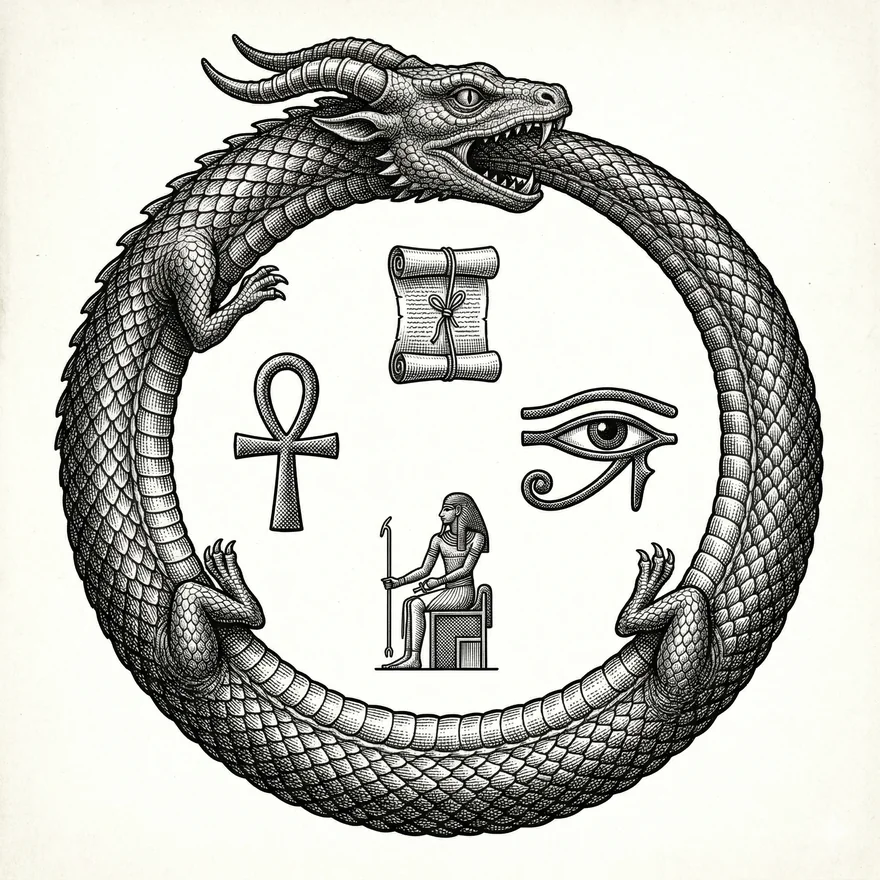
The autonomous Ouroboros: no longer the automates' hourly loop, but the principle itself — Synedre is corrected by those who challenge it.