SYSTEM / Iconography
Symbols
The visual bestiary of Synedre. Each image carries an idea of the system — the Ouroboros, the Council of monks, the Octopus totem, Atlas, Sun Wukong, the Drill and Ursa Major. The visual layer of the doctrine.
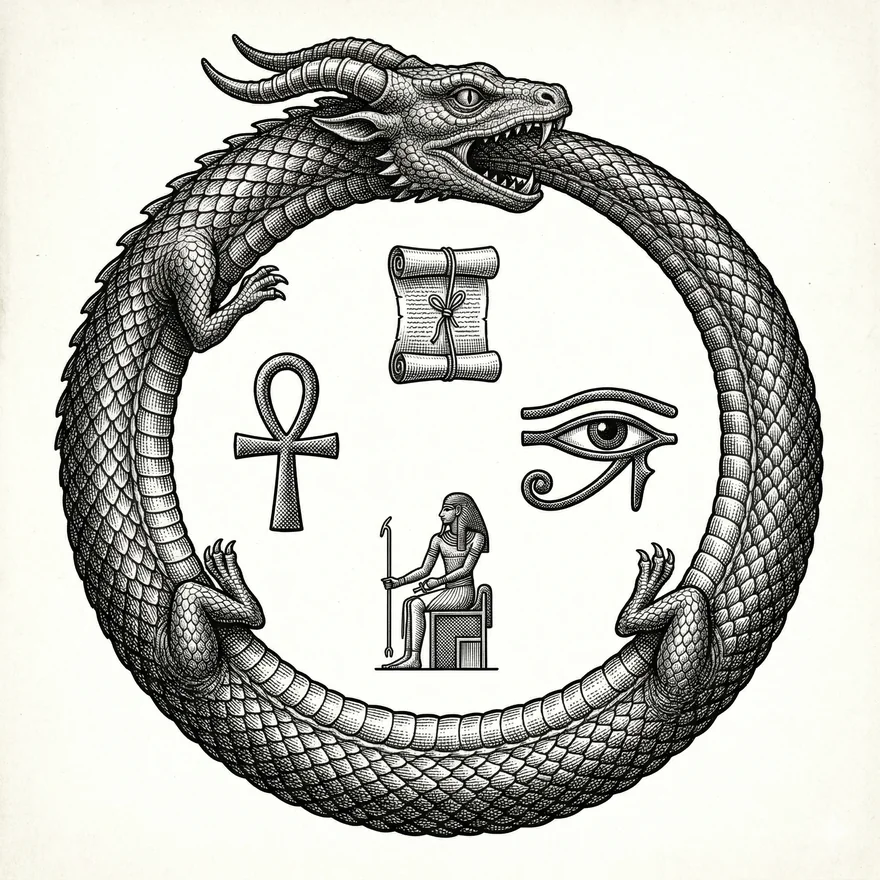
οὐροβόρος — the serpent that feeds on itself
The Ouroboros
The Ouroboros — the serpent biting its tail — is the oldest symbol of the loop that feeds on itself. It is the motion of Synedre: each turn feeds the next, each scar becomes a rule, each critique becomes a law.
At the centre of the engraving, four ancient signs. They are not decorative: each one carries a meaning — the ankh life, the parchment the memory that records, the Eye of Horus vigilance (what is broken returns stronger), and the seated sovereign-scribe the sovereignty of the human who decides and inscribes the law.
- The OuroborosThe self-feeding loop — the system that improves with every turn.
- The ParchmentThe memory that records — each scar becomes a rule, each turn feeds the next.
- The AnkhLife — the agents that bring the system to life.
- The Sovereign-ScribeHuman sovereignty and memory — the human writes the law, the AI executes it.
- The Eye of HorusPermanent vigilance — what is broken returns stronger.
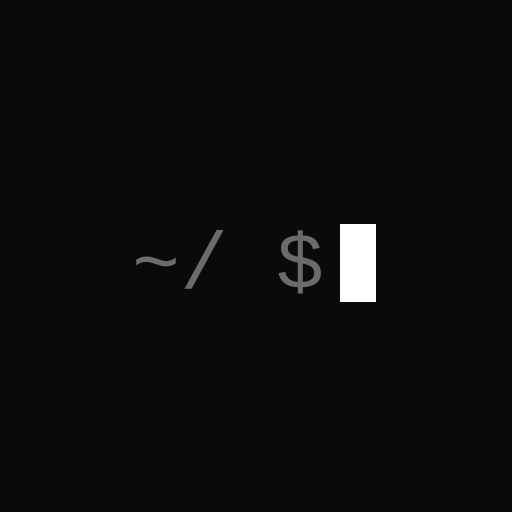
The question asked from home
The Threshold
The very first words of the site, white on black, before even its name: "What if we lived inside a synedre?". The most fundamental question, posed at a terminal prompt — because we do not ask it from nowhere, but from home.
Three characters carry the whole meaning. ~: the home directory, "home" — and ~ is, literally, where one lives (not where one exists: we chose the verb of agency). $: an ordinary user’s prompt — a question, never a statement; the system waits. The blinking cursor does not answer: the answer is not typed — it awaits you.
And what if "home" were already a synedre, without our ever having named it? The Threshold does not decide. It lets you read the question, then enter — and it vanishes, for you are now inside.
- HomeYou question from a place, not from the void — where one lives.
- The promptAn ordinary user: a question, not a statement. The system waits.
- The cursorIt blinks: the answer is not written — it awaits you.
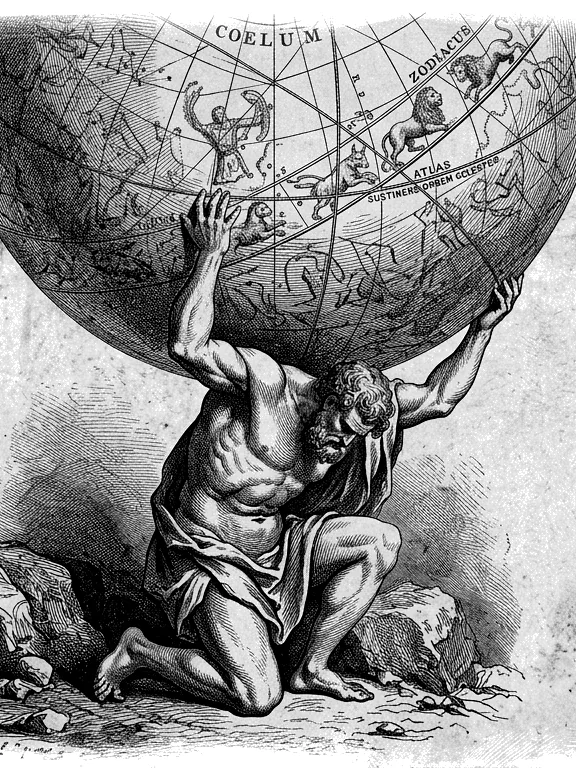
The Greek heritage — bearing the world
Atlas
Atlas, the titan condemned to bear the vault of the sky. It is the name of Synedre’s orchestrator — the one who carries the context, the weight of decisions, the burden no one else holds.
First of the brand’s two gazes: the Greek heritage. Rigour, measure, the burden assumed.
Atlas is also an allegory: the moment one stops being carried and becomes the one who carries — the passage into adulthood, the day a new life depends on yours. The sky on your shoulders is not a punishment: it is what you accept when you grow up. And one does not carry for oneself, but for what one will leave to those who follow — a lesson in courage: to hold up the sky without ever setting it down.
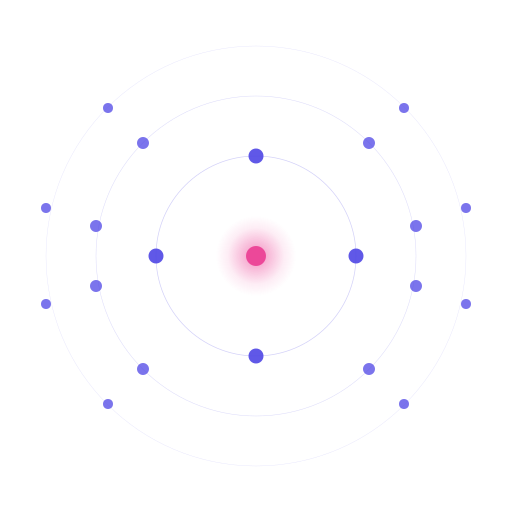
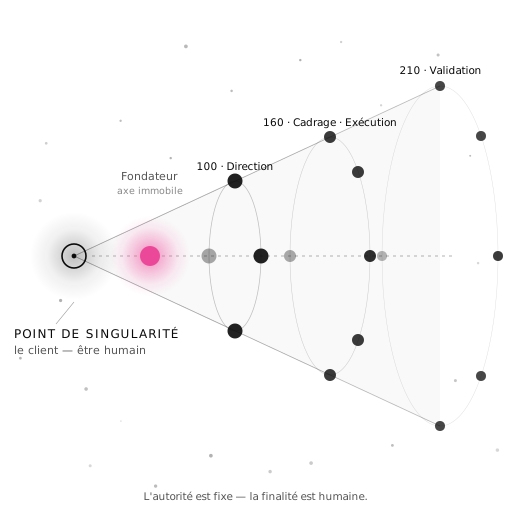
Cutaway view — the focus on the left is the client; the orbits open out to the right. The Founder holds the axis; the finality is human.
The animated pictogram — the agents orbiting the Founder
The Three Orbits
Synedre’s animated pictogram renders the law of orbits: at the centre, the Founder, motionless; around it, the agents gravitating at three distances from the decision — Direction, Framing, Execution. The rings turn at different speeds, but the centre never moves. Power circulates; authority stays fixed.
And in the background, an almost invisible dust: the dark matter — Sun Wukong, the 火眼金睛. It neither orbits nor shows itself, yet it is what weighs everywhere and keeps the orbits from scattering.
The top view tells the order; the cutaway tells the purpose. Tip the axis and a point appears, until now hidden behind the Founder: the singularity point — the client, the human being. The Founder is the fixed axis, never the end; the finality stands outside the circle, and it is toward it that the whole organism leans.
We call “singularity” the moment the machine surpasses man. Synedre turns the word around: here, the singularity is the human — not the most powerful, but the only one that can be an end, and the only one who answers for it. Power may flow to the agents; the finality, never. Authority is fixed; the finality is human.
- The CoreThe Founder, fixed at the centre — the decision does not orbit.
- The Three OrbitsDirection, framing, execution: three distances from the heart of the decision.
- The AgentsTwenty advisors gravitate; an agent can change orbit depending on the chantier.
- The MotionThe rings turn at different speeds — the centre holds, the organism breathes.
- Dark matterSun Wukong, the gaze: neither agent nor orbit, the invisible mass that holds it all.
- The Singularity PointBehind the Founder, outside the circle: the client. They say the singularity is the machine; here it is human — the only one that can be an end.
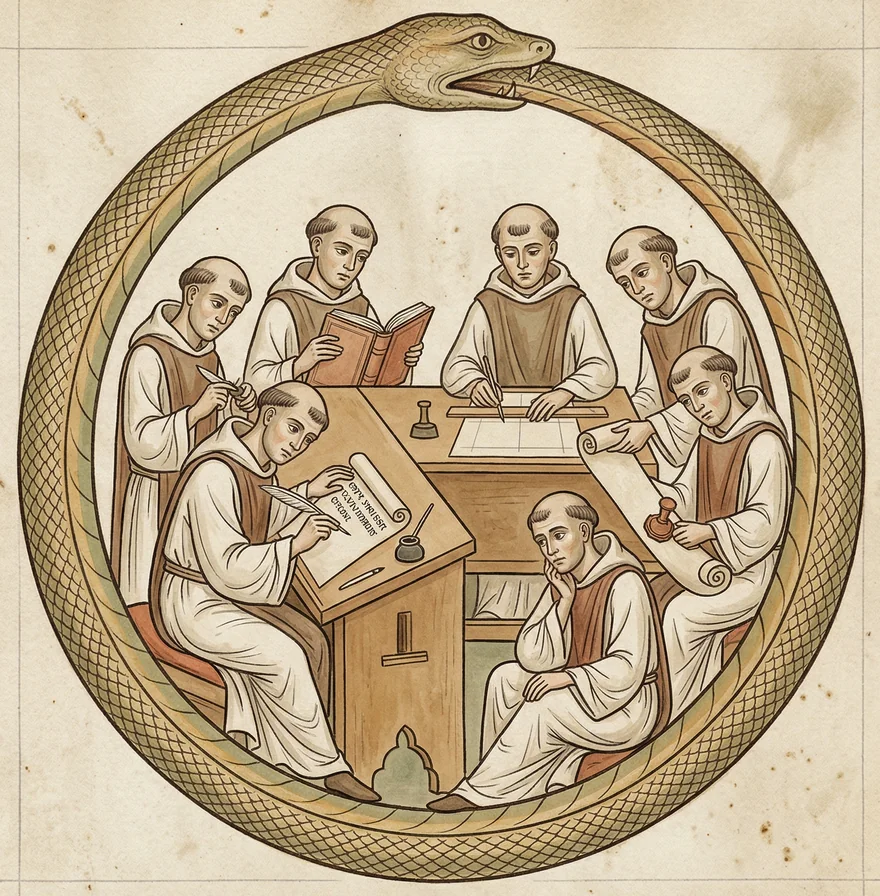
The Liturgy of the Hours
The Council
An illumination: copyist monks in council, each at their task, within the circle of the Ouroboros. It is the truest image of the mothership. The agents think — they deliberate, decide, write. The automata execute — deterministic, silent, never improvising.
As the Liturgy of the Hours set the rhythm of the monastery, the automates set the rhythm of the system: dozens of runs a day, sorted into castes, orchestrated by Renoir, the stage director.
- OraclesAnticipation — foreseeing before the signal arrives.
- BuildersInfrastructure — what keeps the system standing.
- ClockmakersMonitoring — the measure of time and drift.
- WatchersSurveillance — the eyes that never sleep.
- WeaversWeaving — linking what was scattered.
- ScribesCreation — engraving knowledge.
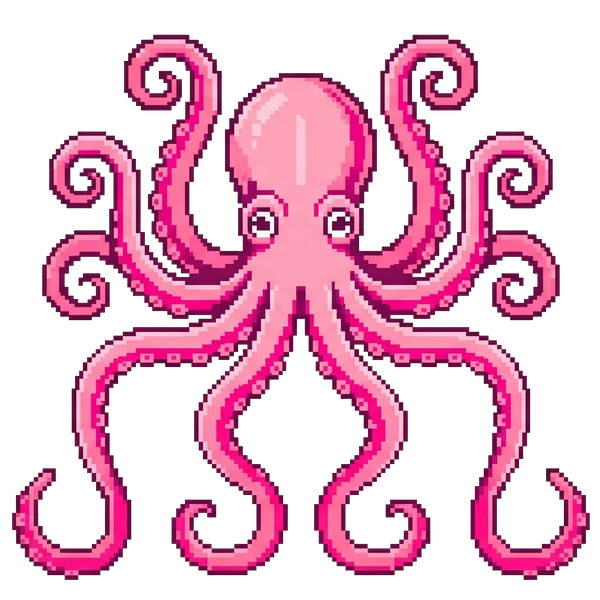
シルカ — the totem, distributed cognition
Shyrka — Syllipsimopodi
Synedre’s totem animal is the octopus, and its name is シルカ / Shyrka, the mothership. A central cognition and semi-autonomous arms that act without routing everything back to the centre. Each arm has its own neurons; the whole remains a single being.
And not just any octopus: Syllipsimopodi, the oldest known ancestor of octopuses — a lineage older than the dinosaurs, one that has survived every great extinction. It lasted because it gave up its shell — trading rigid armour for intelligence and suppleness.
The exact opposite of proprietary lock-in: openness as a condition of survival, not a concession. What has no shell outlives the ages.
- The headShyrka, the mothership — the central cognition that carries the context.
- The armsThe agents — semi-autonomous, each with their own neurons.
- No shellOpen-source — openness as strategy, the opposite of lock-in.
- SurvivalOlder than the dinosaurs — the lineage that outlives extinctions.
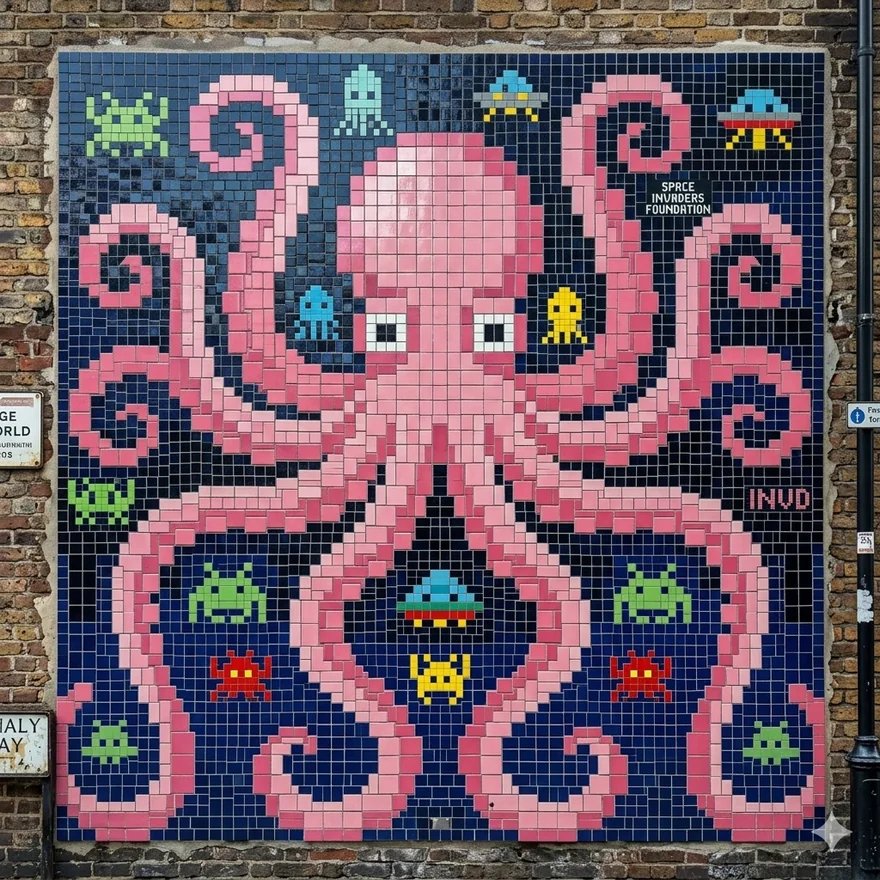
The octopus in mosaic — the pixel DNA
The Invader
The same octopus, but in tile mosaic — in the lineage of pixel-art and 8-bit street art. Each tile is a pixel: alone it is nothing, together they make the totem. Distributed cognition, this time set on a wall.
Around it, the little invaders: the skate-and-arcade DNA of Synedre. We build serious things without taking ourselves seriously — and the totem doesn’t live only in the servers, it goes out into the street.
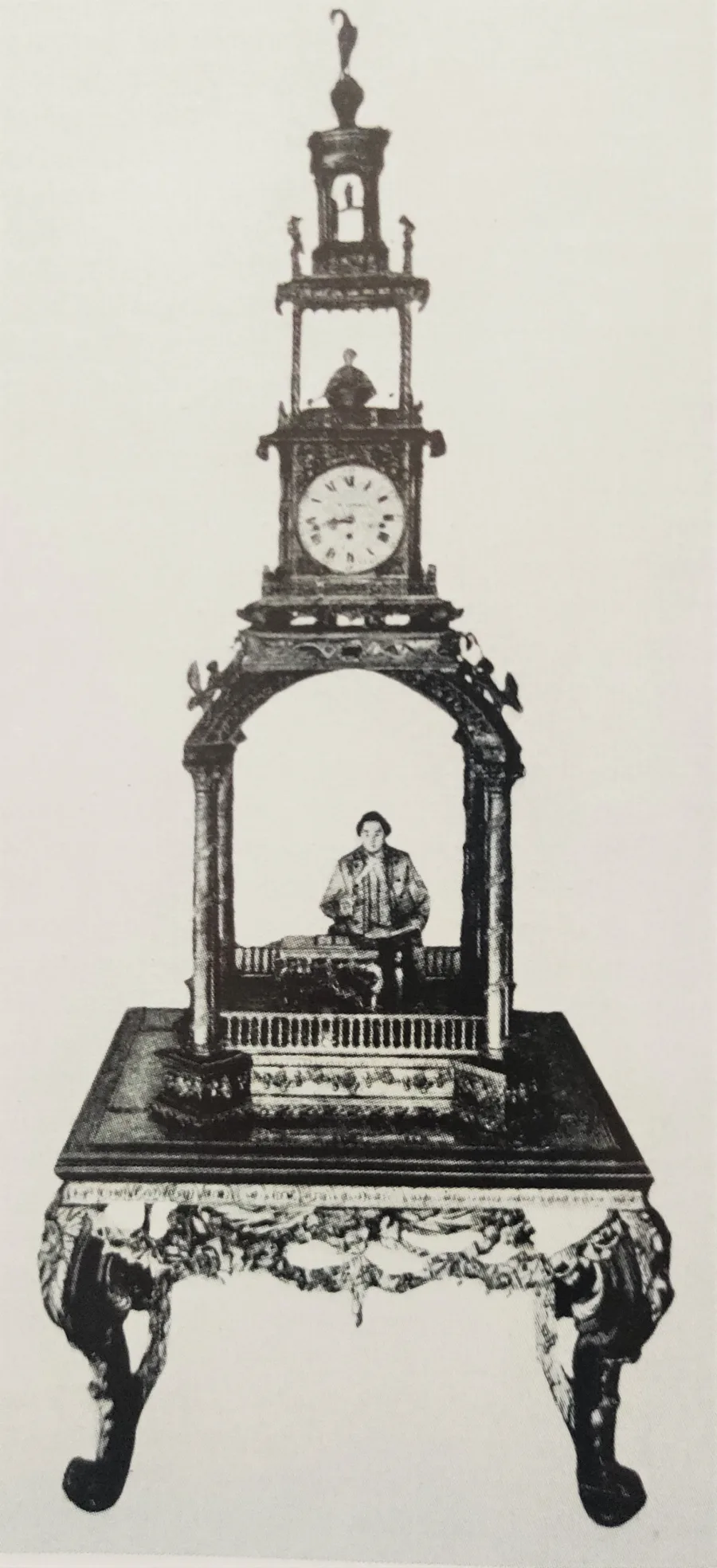
Calligrapher automaton (Jaquet-Droz – Maillardet workshop), Williamson clock (London), found in Peking. Plate from the Palace Museum catalogue, Peiping, 1933. Photographer unknown — public domain.
The executor — the perfect gesture, never the mind
The Automaton
A Chinese calligrapher, brush raised, traces characters. Yet the automaton was born in London: a West building itself a mechanical East at the very hour it was subduing it — the century of gunboats and opium. The gesture is true, the writing is sacred — and behind it, nothing thinks. A graven cam commands every stroke: the machine executes the art of writing without writing anything.
It is the exact image of the second law — the agent thinks, the automaton executes. A mechanism can imitate even the most sacred of human gestures, the calligrapher’s hand, and render it flawlessly, soulless. That is why it is never handed the decision: a perfect gesture in the wrong place, a script that judges is a script that fails in silence.
- The camThe graven program — the deterministic gesture, faithful to the stroke.
- The brushThe art of writing imitated to perfection, without the mind that made it.
- SilenceThe executor does not decide — the judgment stays with the agent.
Training — knowledge becoming reflex
The Drill
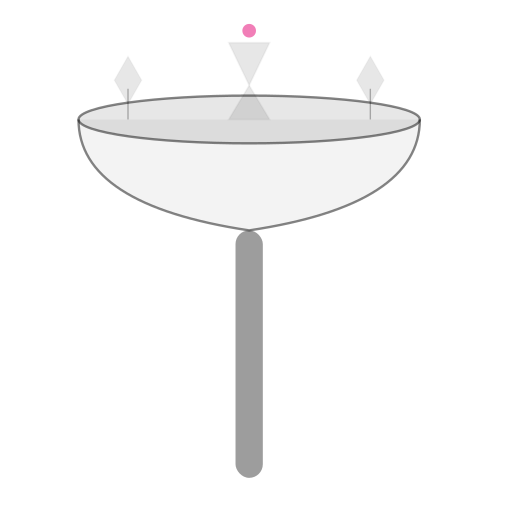
The Drill is the agents’ training protocol. Each room subjects the agent to calibrated stress-tests — real trials drawn from past situations. Knowledge becomes reflex, rule becomes instinct.
A scar first, then a law. The Drill ensures the system never repeats its mistakes: what failed once is codified, replayed, assimilated until it cannot fail again.
- Stress-testThe calibrated trial — simulate failure to prevent it.
- ScarEvery coded error becomes a permanent rule.
- PrecisionThe agent’s fitness — detection, precision, reflex.
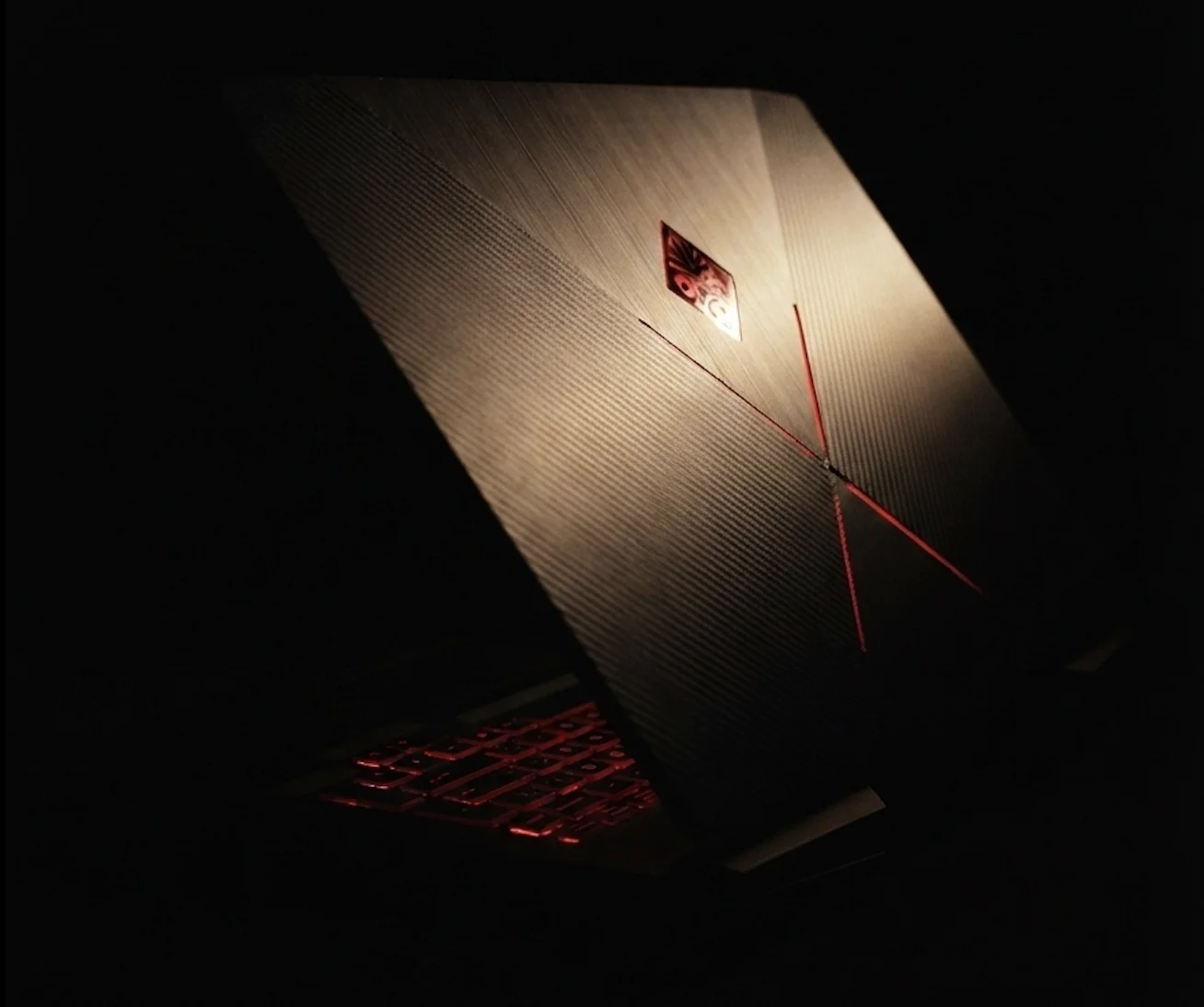
Bucephalus — the OMEN box, at home, in a cupboard. The only member of Synedre you can unplug.
Βουκέφαλος — the mount, turned to face the sun
Bucephalus
The emblem of the body — the only machine in the bestiary you can touch. An OMEN box sitting at home, in a cupboard by the front door: the physical arm of Synedre. Where the other symbols are ideas, this one has a power socket.
Βουκέφαλος, “ox-head” — the horse no one at Philip’s court could ride. Alexander, twelve years old, did not break him by force: he saw the animal was afraid of its own shadow, turned him to face the sun, and mounted. What stops a mount is almost never its power — it is what it believes it sees. That is the discipline of every failure here: find the shadow before pulling on the reins.
Bucephalus carries the gestures the cloud refuses or bills for: a real browser holding a live session, trademark searches on TMview, logo boards, 3D renders, market watch. It runs at our place, it is audited by no one, it costs nothing per call. The Golden Band restrains; Bucephalus carries.
- The mountThe only symbol with a body: a box, at our place, plugged into the wall.
- The shadowWhat stops the machine is not its power but what it believes it sees. Turn it to face the sun before forcing.
- The stableWhat runs at home is not billed per call and cannot be cut off without us.
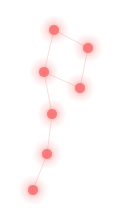
The bearing — the 7 stars of the Great Plough
北斗神拳
Seven stars, a stable shape in the turning sky. Ursa Major — Hokuto, the "Northern Dipper" — points North and guided navigators before any instrument. Within Synedre it is the bearing: finding your direction when everything moves around you.
The seven stars are also the seven scars of Fist of the North Star, etched as the Great Bear on the fighter’s chest. It is Synedre’s doctrine made constellation: each scar becomes a guardrail, and read together the wounds do not speak of pain — they show the way. What broke you orients you.
It is the star kept by Hill, guardian of the North Star: the vision that never drifts. For the real game is no longer labour, it is judgment. In the life-size game Altman and Amodei foretell — one person, agents, a billion — the final boss is not power: it is holding the course. Ursa Major is that fixed point.
- The BearingFinding your direction when everything moves — the fixed shape in the turning sky.
- The Seven ScarsFist of the North Star: wounds etched as the Great Bear. What broke you orients you — each scar a guardrail.
- The North StarHill’s star, guardian of the vision: the bearing that never drifts.
- The Final BossAltman’s life-size game: one person, agents, a billion. The final boss is not power — it is holding the course.
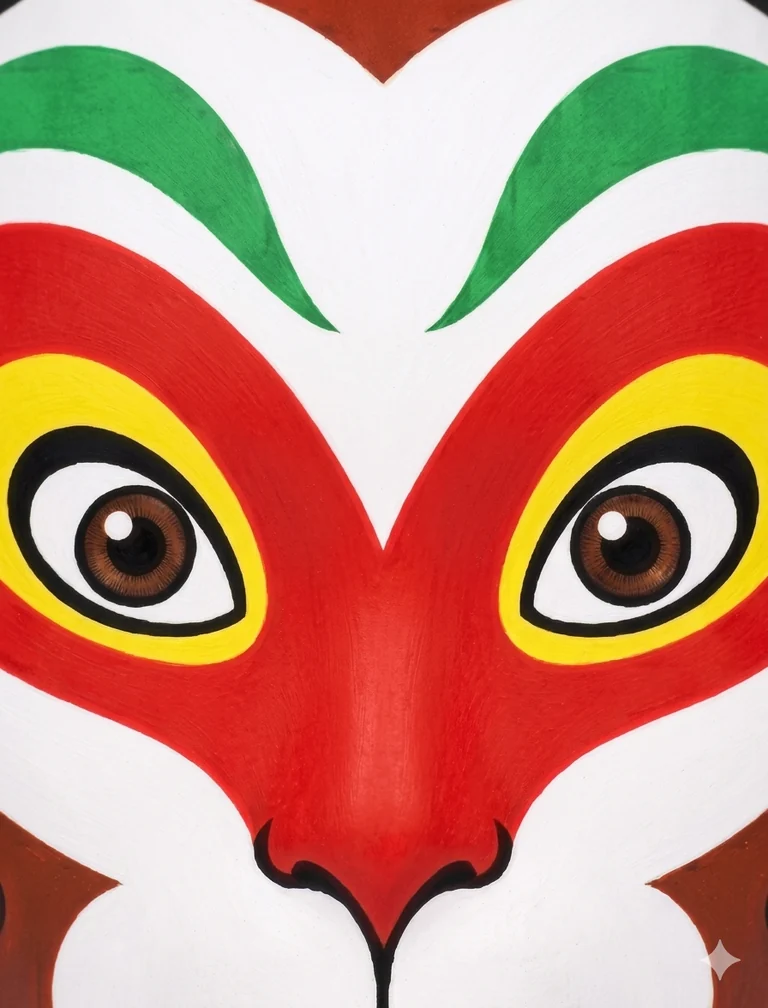
火眼金睛 — the Chinese heritage
Sun Wukong
Sun Wukong, the Monkey King, emerges from the alchemical furnace with the 火眼金睛 — the fiery eyes with golden pupils, able to see through every illusion. Disguised demons, false calm: nothing escapes him.
Second gaze of the brand: the Chinese heritage. The chaotic outsider who became the most reliable guardian. Two heritages, one gaze.
And the eye is not enough. Guanyin sets the 金箍 upon his head — the golden band that bridles the Monkey’s chaos. It is this mastery that turns the troublemaker into a guardian: the road is given only to what has first been held. To see, then to master oneself.
But Wukong is not an agent: he does not orbit. He is the system’s dark matter — invisible, everywhere, the mass you cannot see but which holds the orbits in place. The agents are the visible matter; the 火眼金睛 is what weighs in the dark and keeps the whole from scattering.
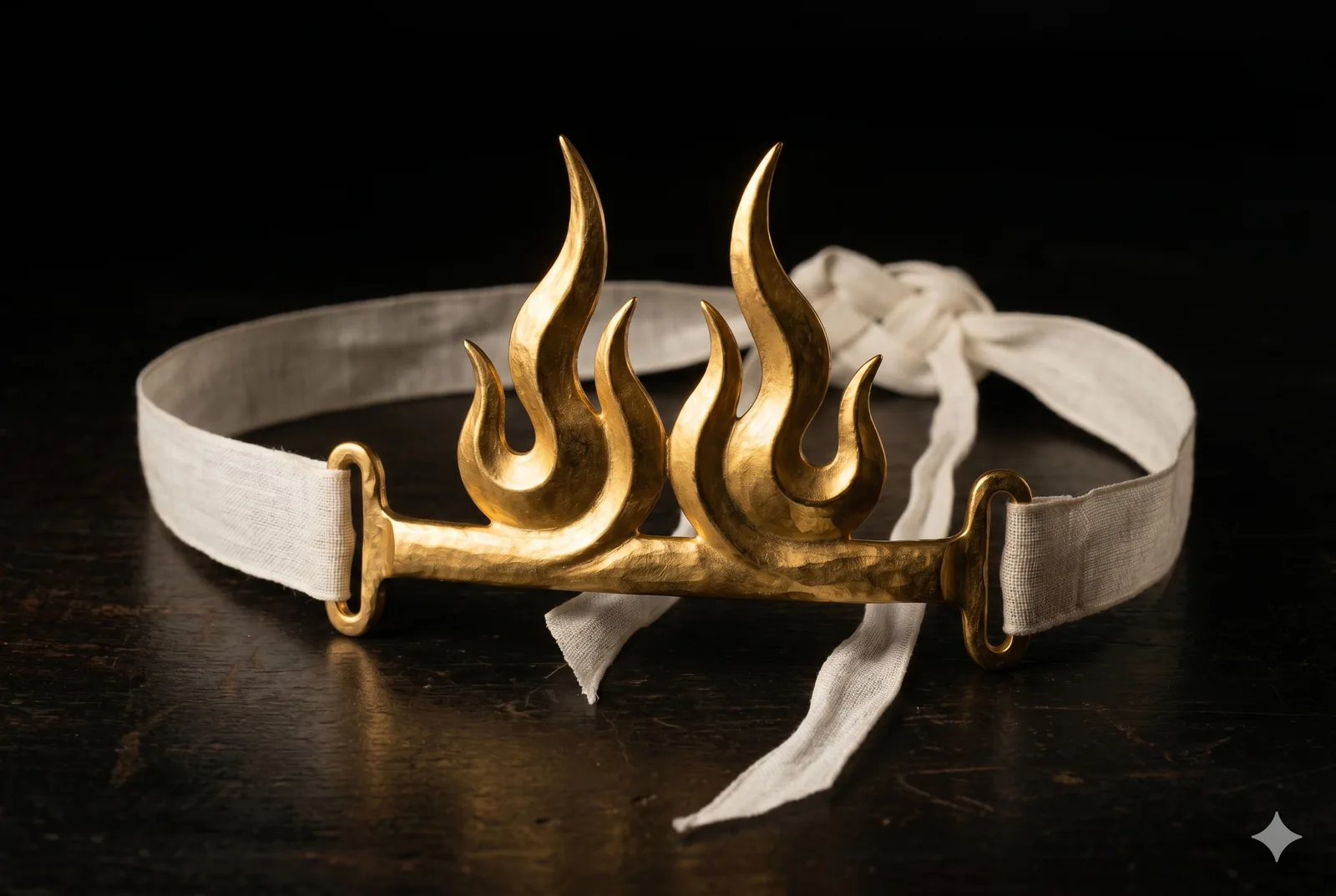
金箍 ⨯ diadem — from the Monkey King to the Greek King
The Golden Band
The emblem of the harness — what holds the agents: hard rules, guardrails, the Drill. One band, two civilisations, read along a single axis.
At the front, the gold: the flames of Sun Wukong’s 金箍 — the circlet that bridles the Monkey King’s chaos. At the back, the linen: the Greek knot (Heracles knot) of Alexander the Great’s diadem — the plain white band that crowned the sovereign. From the Monkey King to the Greek King.
Gold that bridles, linen that crowns. The same band bridles and crowns: one only presides on condition of first mastering oneself. What has been tamed can be entrusted to the road — that is what makes autonomy possible.